

 DEV

What happened, precisely
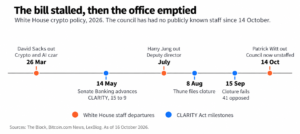
Witt was executive director of the President’s Council of Advisors for Digital Assets. He was also a Department of Defense employee on temporary loan, an arrangement called a detail, which returns the officer to their home agency when it lapses. That is what the White House confirmed to The Block on Wednesday.
The confirmation reached Crypto In America’s Eleanor Terrett by email and she posted it on X. The White House did not answer questions about a replacement.
I’ve emailed the @WhiteHouse three times over the past week seeking comment on whether @patrickjwitt is still serving as executive director of the White House Crypto Council. No response. Witt declined to comment.
A source familiar with the matter tells me Witt is a Department of Defense employee on temporary detail to the Crypto Council. That detail has either expired or is about to, and it’s unclear whether it’ll be renewed. Witt also deferred his service in the Georgia National Guard earlier this year and is expected to resume it.
Witt was the council’s only remaining staffer after Deputy Director @HarryYJung left at the end of July and @davidsacks47 tenure as crypto and AI czar ended earlier this year.
Now the question in crypto policy circles: Is the White House still prioritizing the industry after the Clarity Act failed to advance in the Senate?
— Eleanor Terrett (@EleanorTerrett) October 14, 2026
Witt himself took the job in August 2025 after Bo Hines left for Tether. He had already stepped away once, in July 2026, for Georgia Army National Guard JAG training, having postponed an April start to stay through the CLARITY negotiations. A second postponement was not available to him.
Why it matters more than a personnel note
The council was the coordination point between the White House, the Senate and the agencies. It is now, as far as anyone can publicly establish, unstaffed.
That lands one month after the thing it existed to deliver failed. On 15 September the Senate did not invoke cloture on the motion to proceed to H.R. 3633. Sponsors had offered 126 changes and opposition still reached 41 votes, which makes 60 arithmetically impossible. Bitcoin slid under $76,000 on the result.
The open fights were never resolved: executive-branch ethics rules given the president’s own crypto holdings, illicit finance provisions, and whether stablecoin yield should be closed off to digital asset service providers the way it is to banks.
With Congress unlikely to move before January 2027, the SEC and CFTC become the venue by default. That is a meaningful shift for anyone planning compliance or a capital raise against a statute that is not coming.


Comments (0)
No comments yet. Be the first to share your feedback below!
Leave a Feedback
We'd love to hear your thoughts on this article.