

 AdminCryptominds

Bank of America, Citi, Goldman Sachs and eighteen others formed a company on 1 September to build a joint dollar stablecoin. Three institutional tracks are now racing toward the same target: Circle.
The announcement, unpacked
Twenty-one financial institutions committed on 1 September 2026 to establish a yet-to-be-named stablecoin company during the second half of the year, subject to closing conditions. The group spans North America, Europe, East Asia, the Middle East and Africa, and includes Bank of America, Citi, Capital One, Goldman Sachs, PNC Financial, Wells Fargo, TD Bank, Scotiabank, UBS, Santander, BBVA, Deutsche Bank, Commerzbank, Lloyds, Crédit Agricole, Rabobank and MUFG, among others.
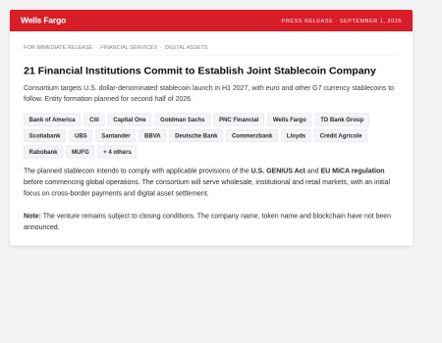
Wells Fargo press release, 1 September 2026 — 21 institutions commit to a joint stablecoin
The target is a 1:1 reserve-backed US dollar stablecoin serving wholesale, institutional and retail markets, with an initial focus on cross-border payments and digital asset settlement. A euro-denominated product is the stated first follow-on currency. Launch is targeted for the first half of 2027, subject to closing conditions, and the venture says it will comply with the GENIUS Act and MiCA before beginning global operations.
What this is not
The September 1 consortium is easy to confuse with two other initiatives, but it stands apart from both. Open USD, announced in June 2026, carries backing from Visa, Mastercard, American Express, Stripe, Coinbase, Ripple and more than 140 other businesses — yet only BBVA appears on both lists. The BankChain Alliance, formed separately by 39 US state banking associations representing 3,283 banks and $21.8 trillion in assets, is building shared infrastructure for tokenised deposits rather than a specific stablecoin. JPMorgan appears on none of these lists.
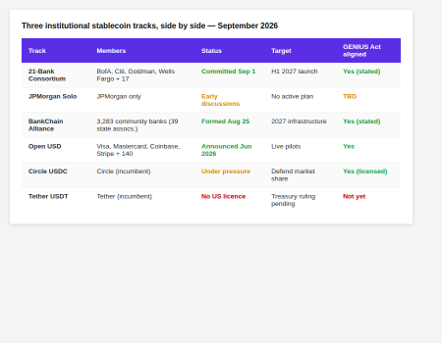
Three parallel institutional stablecoin tracks — September 2026
JPMorgan’s own position remains exploratory. The Wall Street Journal reported on 26 August that the bank is weighing its own stablecoin alongside JPM Coin, its existing tokenised-deposit product. JPMorgan has since confirmed only that it has held early discussions and has no active launch plan.
What it means for Circle
Circle is the most directly exposed incumbent. The company’s revenue depends primarily on interest earned on USDC reserves — a model threatened by any competitor that captures market share. Morgan Stanley analyst James Faucette downgraded Circle to Underweight in August, with a $38 price target. The September 1 consortium is the second institutional-scale competitive pressure to arrive in a single quarter, following Open USD’s launch in June.
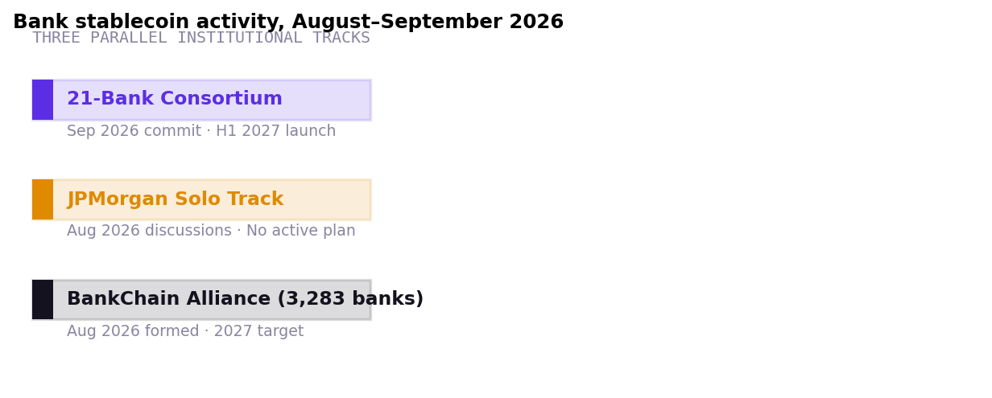
Timeline of the three parallel institutional bank stablecoin tracks.
The regulatory backbone
All three tracks have the GENIUS Act to thank for a clear federal path. President Trump signed the legislation on 18 July 2025, requiring 1:1 reserve backing, redemption protections and regular reserve disclosures. Implementing regulations missed the 18 July 2026 rulemaking deadline — a delay that may actually benefit established crypto-native issuers in the short run by pushing back the competitive pressure the new entrants represent.
Tether’s position in the US market remains unresolved. The Treasury has not yet issued a reciprocity determination that would let USDT operate inside GENIUS Act regulation. Without one, USDT could be locked out of the regulated US market once enforcement begins.
Sources
- Payments Dive, 2 September 2026
- news, 2 September 2026
- Benzinga, 1 September 2026
- TechTimes, 2 September 2026
- Yahoo Finance / WSJ, 26 August 2026


Comments (0)
No comments yet. Be the first to share your feedback below!
Leave a Feedback
We'd love to hear your thoughts on this article.