

 AdminCryptominds

The shake-out is finished and the numbers are blunt
The transition period under the EU’s Markets in Crypto-Assets regulation ended on 1 July 2026. Since then, platforms without authorisation cannot offer regulated services to customers in the European Economic Area.
The clear-out was severe. Around 2,700 crypto firms were registered before MiCA and a little over 200 hold a licence now, analyst Crypto Tice wrote on 4 August, an attrition rate of roughly 90 percent.
BREAKING:
Europe’s crypto shake-out is done. The number is brutal.
2,700 registered crypto firms before MiCA.
Just over 200 hold a license now.
A 90% attrition rate.Running a licensed CASP is 10 to 15 times harder than the old VASP registration.
The transition period ended… pic.twitter.com/pFGtNMsbsG
— Crypto Tice (@CryptoTice_) August 4, 2026
The ESMA register listed 309 crypto service providers in August, including new entries such as BNY SA/NV. For e-money tokens the same register carried 22 authorised issuers as of an 8 August audit.
Circle is not close to losing the lead
The euro-denominated stablecoin market is growing, but stays small next to the dollar tokens. Eight MiCA-compliant euro stablecoins reached a combined $673.9m in June 2026, up from $295.6m a year earlier.
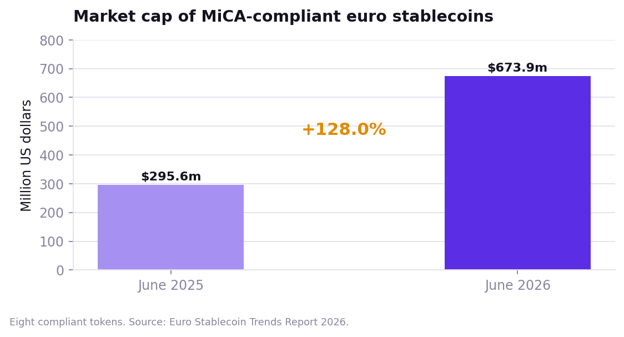
[CHART 1: euro-stablecoins.png — Caption: Market capitalisation of MiCA-compliant euro stablecoins, year on year.]
Circle said on 17 August that EURC had passed 400 million euros in circulation. In dollar terms that is roughly $526m and about 63 percent of the entire euro segment.
The chasing pack is a long way back. Société Générale Forge’s EUR CoinVertible averaged about $137.8m across the year, Banking Circle’s EURI about $51.1m and Monerium’s EURe just under $30m.
Several older tokens have dropped out of the compliant field entirely. Euro Tether was discontinued in late 2024, Stasis Euro no longer appears on the ESMA register, and Angle Euro’s algorithmic design cannot qualify as an e-money token.
Revolut joins, Germany supplies the bank issuer
On 20 August Revolut opened the public offer for its euro stablecoin EURR. The issuer is Luxembourg-based Bridge Building S.A., supervised by the CSSF, which filed its MiCA notification with ESMA on 23 July.
Distribution starts in Denmark, Poland and Portugal through Revolut Digital Assets Europe in Cyprus. EURR is live on Ethereum and Polygon, with the whitepaper and reserve data published.
The ticker is a trap worth flagging. A second token using EURR is issued by StablR under Maltese MFSA supervision, with a different issuer, a different authority and a different Ethereum contract.
The largest stablecoin in the world is absent from both registers. Tether holds neither an EU e-money licence nor a banking licence, which is why regulated venues can no longer offer USDT to European customers in full.
Germany supplies EURAU from AllUnity, the first MiCAR-compliant euro stablecoin from a BaFin-licensed entity. That supervisors intend to enforce is clear from Austria, where the FMA fined broker Bitpanda 70,000 euros over MiCA breaches.
The digital euro is still a 2029 project
The central bank version is moving on a separate track. In an FAQ updated on 17 August, the ECB confirmed that trilogue negotiations between Commission, Parliament and Council have begun.
The bank still expects the legal framework could be adopted by the end of 2026. A twelve-month pilot with 36 selected payment service providers would start in the second half of 2027, with a first issuance possible no earlier than 2029.
None of that is a launch date. The Governing Council only decides on actual issuance once the legislation is in place.
Sources
- Circle, 17 August 2026
- com MiCA stablecoin list, 27 August 2026
- Cryptonomist, 6 July 2026
- eu ESMA audit, 8 August 2026
- ECB digital euro FAQ, 17 August 2026
- Bitcoin Foundation, 17 August 2026


Comments (0)
No comments yet. Be the first to share your feedback below!
Leave a Feedback
We'd love to hear your thoughts on this article.