

 AdminCryptominds
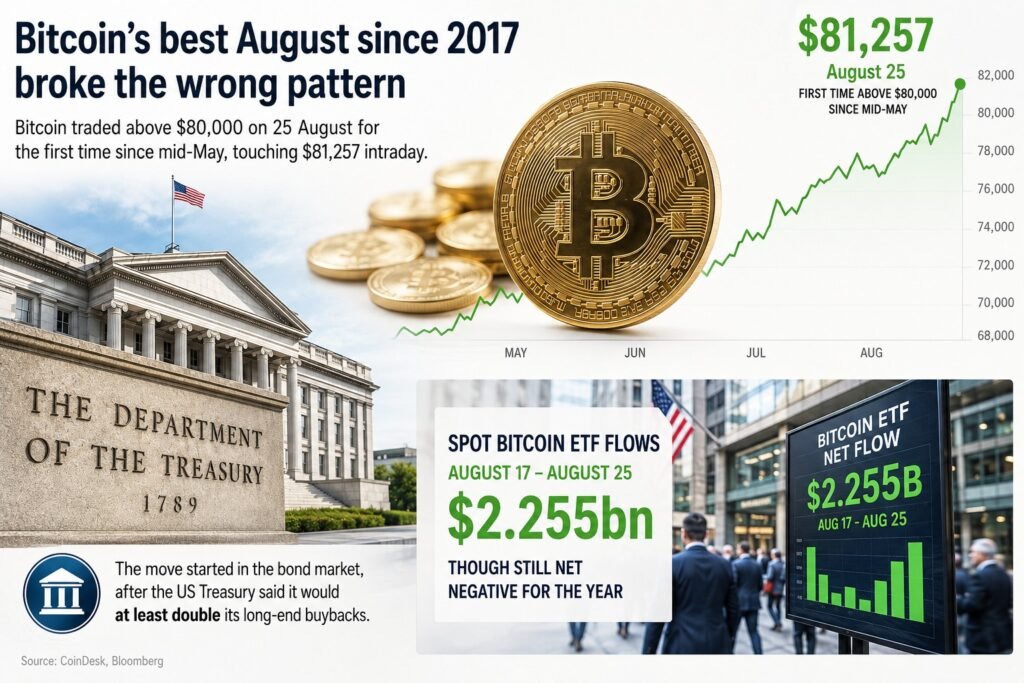
August rewrote a seasonal script Bitcoin usually follows
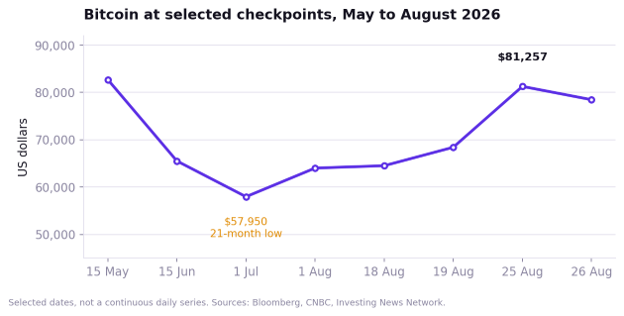
Bitcoin ended a month almost nobody had positioned for. After bottoming at $57,950 on 1 July, its lowest print in 21 months, the price spent the first half of August parked in the mid-$60,000s and doing very little.
On 19 August the range broke. Bitcoin left the $64,000 area, reached an intraday high near $69,749 and settled around $68,400 by the close of the US session.
Six days later, the next level was breached. On 25 August the price ran to $81,257, back above $80,000 for the first time since mid-May, before giving up most of the gain during New York hours.
That still leaves it a long way below October’s peak of roughly $126,000. Measured against its own seasonality, though, the month stands out, because since 2013 Bitcoin’s median August return has been about minus 6.99 percent.
The trigger sat in the bond market, not the order book
The impulse did not come from crypto. The US Treasury said it would expand its long-end liquidity buybacks from $2bn to at least $4bn per operation, starting 9 September and running into early November.
Rates moved first. The 30-year yield fell from about 5.34 percent toward 5.18 percent, and the 10-year eased to roughly 4.65 percent.
The dollar index dropped 0.75 to 0.9 percent, toward 98.90. Only then did crypto move, and the move was amplified by forced liquidations among traders positioned for lower prices.
Ether cleared $2,000 and printed near $2,100 during the session. As of publication Ether trades at $2,470.44, XRP at $1.48 and Solana at $96.55.
What the ETF numbers actually say
US spot Bitcoin ETFs pulled in $337.6m on 25 August, a sixth consecutive positive session. BlackRock’s IBIT supplied $208.9m of that and Fidelity’s FBTC $104.6m.
Across the week to 25 August, Bitcoin funds absorbed about $1.92bn and Ether funds about $697m, for a total of roughly $2.705bn across nine tracked products.

Category net assets climbed from $78.67bn to about $98.56bn on one compilation, a 25.3 % jump that price appreciation did most of the work for. Cumulative net inflows since launch stand near $54.50bn.
The year-to-date picture is less flattering. Across 2026 the category remains about $2.91bn net negative, so August’s streak has clawed back only part of what was left earlier.
Breadth backed the move. Total crypto market capitalisation pushed through $2.32tn on 19 August, and the Fear and Greed Index climbed out of the high twenties into the mid forties, which is neutral rather than greedy.
Strategists reached for an old comparison. BTIG’s Jonathan Krinsky noted that Bitcoin did something similar in January 2023, surging around 20 % in three days and breaking its downtrend, while Ray Dalio’s warning about a debt crisis and his suggestion that investors hold a little Bitcoin provided a macro narrative to support the move.
Then the inflation print reclaimed the tape
The run ended on 26 August. The Bureau of Economic Analysis put July core PCE at 3.3 per cent year over year, exactly where the market expected it.
Headline PCE came in at 3.7 per cent against a 3.6 percent forecast. Bitcoin slid back under $78,000, gold broke below $4,600 an ounce, and US equities opened lower.
As of publication on 29 August, Bitcoin trades around $78,451. The Fear and Greed Index had reached extreme greed shortly before, for the first time since late 2024.
Sources
- Bloomberg, 25 August 2026
- CNBC, 24 August 2026
- Investing News Network, 26 August 2026
- Toobit daily recaps, 19 and 26 August 2026
- MoneyMagpie, 20 August 2026


Comments (0)
No comments yet. Be the first to share your feedback below!
Leave a Feedback
We'd love to hear your thoughts on this article.